
Do I Really Need Foot Surgery? What to Know Before Making the Decision
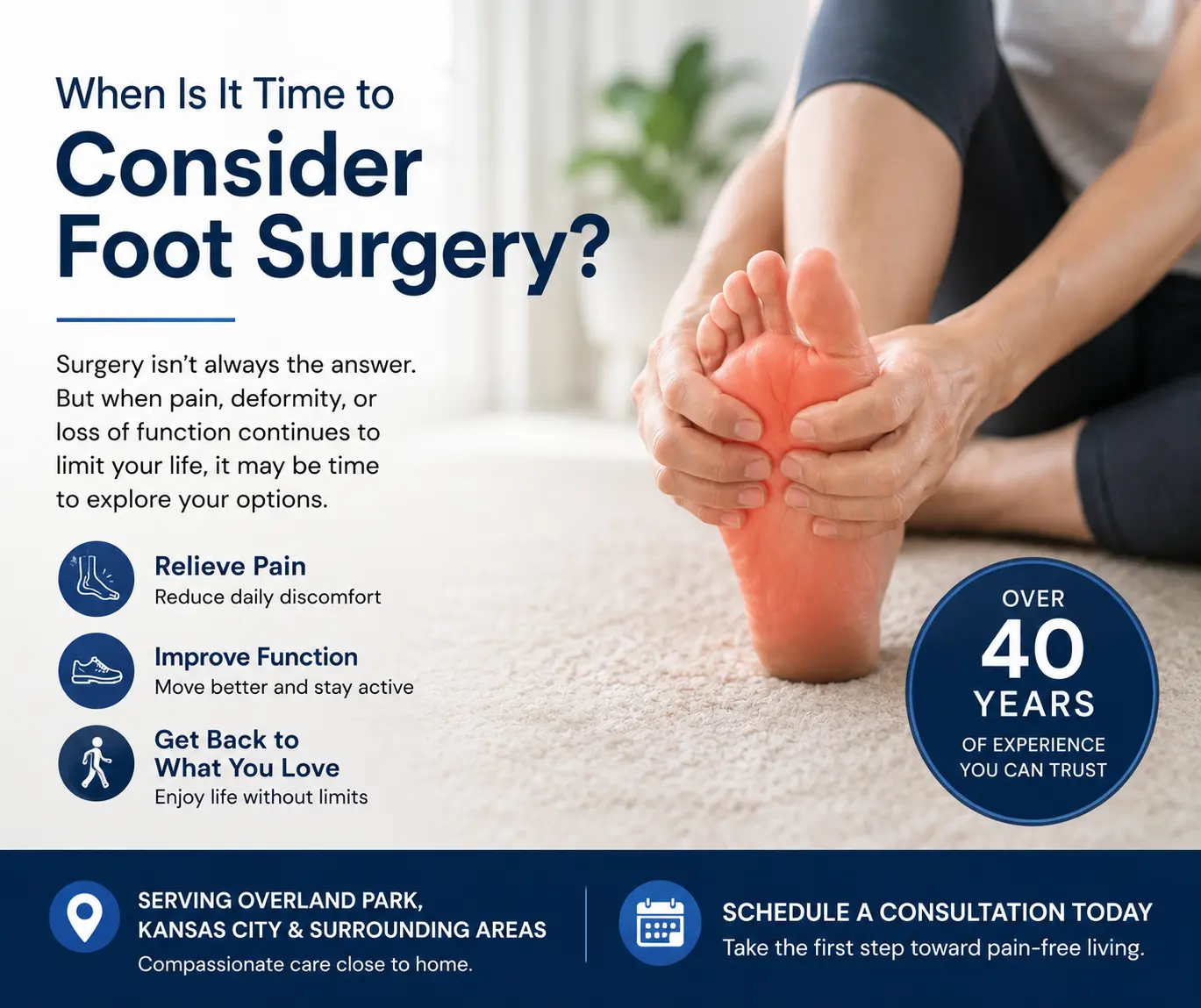
"You need foot surgery."
For many patients, those words immediately lead to more questions.
Do I really need it?
What happens if I wait?
Is there another treatment I could try first?
How difficult will recovery be?
Should I get another opinion?
These are exactly the questions you should be asking.
Foot surgery can be an effective way to correct certain painful structural problems, but surgery should not be recommended simply because an abnormality exists on an X-ray or because you've reached a certain age.
The decision should be based on the problem, your symptoms, how the condition affects your life, treatments you've already tried, and whether surgery offers a reasonable path toward improving function and reducing pain.
At KC Foot Care, Dr. Thomas Bembynista has treated foot and ankle conditions in the Kansas City area for more than four decades. His philosophy is straightforward: start with conservative treatment whenever appropriate and consider surgery when the patient's condition warrants it.
Here's what to understand before making that decision.
When Is Foot Surgery Actually Necessary?
Foot surgery may become appropriate when a structural problem causes persistent pain or loss of function, continues to progress, or does not respond sufficiently to appropriate conservative treatment.
The important word is may.
There isn't one universal threshold that determines when everyone with a bunion, hammertoe, bone spur or other foot condition needs surgery.
Two people can have similar-looking X-rays and very different symptoms.
That's why the decision should be individualized. If you're trying to understand the signs that may indicate it's time for a surgical evaluation, you can also read our guide to when to consider foot surgery.
The real question isn't:
"Can this problem be operated on?"
It's:
"Is surgery the most appropriate option for me right now?"
Start With the Diagnosis, Not the Procedure
Before deciding whether you need surgery, you need to understand exactly what is causing your symptoms.
Foot pain can have many causes, and the location of the pain doesn't always reveal the underlying problem.
A comprehensive evaluation may include:
- Your medical and surgical history
- How and when the pain occurs
- Changes in activity
- Footwear
- Previous treatments
- Physical examination
- Digital X-rays or other imaging when appropriate
- Evaluation of the structure and mechanics of the foot
Once the diagnosis is clear, treatment options can be compared. A surgical evaluation should consider your symptoms, how the condition is affecting your daily life, whether it is progressing and what treatments you've already tried. You can learn more about the factors that may lead to a surgical evaluation in our guide to evaluating when foot surgery may be appropriate.
This is particularly important if you've already been given a surgical recommendation but aren't sure why that specific procedure was chosen.
Have You Exhausted Your Nonsurgical Options?
Not every conservative treatment is appropriate for every condition, and "I've tried everything" can mean very different things from patient to patient.
Depending on the problem, conservative treatment may include:
- Shoe modifications
- Padding or protection from pressure
- Custom Orthotic support
- Activity modification
- Anti-inflammatory treatment
- Injections
- Other condition-specific treatments
For many patients, these measures provide enough relief that surgery isn't necessary.
But there is an important distinction between relieving symptoms and correcting a structural deformity.
Consider a bunion.
Changing shoes, using padding or orthotics and treating inflammation may make a bunion more comfortable. However, these measures don't physically realign the underlying bone deformity.
If the bunion continues progressing and interfering with daily life despite appropriate conservative care, surgery may become a reasonable discussion.
What Happens If I Wait to Have Foot Surgery?
The answer depends on the condition.
Some foot problems can be managed conservatively for years without creating an urgent need for surgery. Others may progressively become more painful, rigid or difficult to accommodate.
A bunion for example, may gradually change the alignment of the big toe and contribute to problems involving neighboring toes.
Hammertoes can progress from flexible deformities to more rigid positions that rub against shoes and create painful pressure points.
Waiting isn't automatically wrong.
But waiting without understanding how your particular condition is likely to behave is different.
Ask your surgeon:
What is likely to happen if I don't have surgery now?
The answer can help distinguish between a procedure that is truly necessary and one that can reasonably be postponed.
How Do I Know If I'm Ready for Foot Surgery?
You may be ready to seriously consider surgery when several factors come together:
Your diagnosis is clear.
You understand what is structurally wrong and what's causing your symptoms.
Your symptoms matter to you.
Pain or deformity is affecting walking, work, exercise, footwear or activities you care about.
You've considered reasonable conservative options.
Those treatments either haven't provided adequate relief or are no longer enough.
You understand the proposed procedure.
You know what will be corrected and why that particular operation has been recommended.
You understand recovery.
You have realistic expectations about walking, footwear, work, exercise and follow-up care.
You feel comfortable with your surgeon.
You have had enough time to ask questions and understand your options.
If one of those pieces is missing, it may be worth getting more information before proceeding.
Should I Get a Second Opinion Before Foot Surgery?
If you're uncertain, absolutely consider it.
A second opinion can be particularly helpful if:
- You've been told surgery is your only option.
- You're unclear about your diagnosis.
- You're uncomfortable with the recommended procedure.
- You haven't received a clear explanation of alternatives.
- You're worried about recovery.
- You want to know whether a less invasive procedure may be appropriate.
- You've previously had foot surgery and are experiencing another problem.
- You simply want confirmation before making a significant decision.
Seeking another opinion doesn't mean the first doctor was wrong.
It means you're making an informed decision about your body.
For additional patient education about foot and ankle surgery, you can also review resources from the American College of Foot and Ankle Surgeons (ACFAS).
Does Foot Surgery Always Mean a Long Recovery?
No.
"Foot surgery" describes a very broad range of procedures.
A small procedure for a bone spur or selected hammertoe is very different from reconstructive surgery for a significant bunion deformity.
Some patients may also qualify for minimally invasive foot surgery.
Dr. Bembynista uses minimally invasive techniques for selected conditions including hammertoes, bone spurs, painful calluses and certain forefoot problems. These procedures use small incisions and specialized instruments and may sometimes be performed in an office setting under local anesthesia.
Other procedures, including certain bunion corrections, are performed in an outpatient surgical setting.
Recovery therefore depends on what is being corrected and how it is being corrected.
Rather than searching for one universal "foot surgery recovery time," ask what recovery looks like for your exact procedure.
What Should I Ask a Foot Surgeon Before Surgery?
Before agreeing to elective foot surgery, you should feel comfortable asking questions.
Consider bringing these to your consultation:
- What exactly is causing my problem?
- Why are you recommending surgery?
- What happens if I don't have surgery?
- Are there nonsurgical options I should try first?
- Which procedure are you recommending and why?
- Are there other surgical approaches?
- Am I a candidate for a minimally invasive procedure?
- When can I walk after surgery?
- When can I return to normal shoes?
- When can I return to work or exercise?
- What are the risks and possible complications?
- What should I realistically expect surgery to improve?
You should leave the consultation understanding the answers.
What Types of Foot Surgery Does Dr. Bembynista Perform?
The appropriate treatment depends on the individual condition.
Dr. Bembynista evaluates surgical options for problems including bunions, Tailor's bunions, hammertoes, bone spurs and other painful structural conditions.
For bunions, the surgical approach is selected according to the patient's specific deformity and foot structure. Options may include traditional bunion correction techniques as well as Lapiplasty for appropriately selected patients.
Selected hammertoes, bone spurs and forefoot conditions may be candidates for minimally invasive surgical techniques.
The important point is that surgery shouldn't be one-size-fits-all.
The procedure should be selected because it makes sense for your foot.
Choosing a Foot Surgeon in Kansas City
Experience matters, but so does communication.
You want a surgeon who will explain what is wrong, show you what they're seeing when appropriate, discuss nonsurgical and surgical options, and give you realistic expectations about recovery.
Dr. Thomas Bembynista has practiced in the Kansas City area for more than four decades and is board certified by the American Board of Podiatric Surgery.
His treatment philosophy emphasizes conservative treatment first and surgical correction when necessary.
For surgical patients, that relationship continues after the procedure. Follow-up care is an important part of the treatment and recovery process.
Frequently Asked Questions About Deciding on Foot Surgery
Does having a bunion mean I need surgery?
No. Many bunions can initially be managed conservatively. Surgery is generally considered when pain, progression or functional limitations continue despite appropriate nonsurgical treatment.
Is foot surgery necessary if I'm not in severe pain?
Not necessarily. The decision depends on the diagnosis, progression of the condition, functional limitations and other individual factors. Appearance alone generally isn't enough to determine whether surgery is appropriate.
Can I see a foot surgeon even if I don't want surgery?
Yes. Seeing a surgeon doesn't obligate you to have a procedure. An evaluation can help you understand your diagnosis, conservative options and whether surgery may ever be necessary.
Can I get a second opinion if another doctor recommended surgery?
Yes. A second opinion can help confirm the diagnosis and recommended procedure or identify alternative treatment options.
Is minimally invasive foot surgery better than traditional surgery?
Not necessarily. Minimally invasive surgery can offer advantages for appropriately selected conditions, but it isn't the right solution for every foot problem. The best technique depends on the diagnosis, severity and individual anatomy.
Can I walk immediately after foot surgery?
It depends on the procedure. Some procedures allow protected weight-bearing relatively quickly, while others require greater restrictions. Your surgeon should provide instructions specific to your operation.
Still Wondering, "Do I Really Need Foot Surgery?"
You don't have to make that decision based on fear, frustration or a quick conversation.
You deserve to understand:
What's actually wrong.
What your nonsurgical options are.
Why surgery is or isn't appropriate.
Which procedure makes sense.
What recovery will realistically involve.
If you've been told you need foot surgery, have exhausted conservative treatment, or simply want another opinion, a surgical consultation can give you the information you need to make the decision confidently.
Dr. Thomas Bembynista sees patients from Overland Park, Johnson County, Kansas City and surrounding Kansas and Missouri communities.
Schedule a foot surgery consultation or second opinion with KC Foot Care and find out what options make sense for you.
About the author

Jessica Harrison is a compassionate healthcare advocate based in Austin, TX. With years of experience navigating the complex healthcare landscape, she understands the challenges many face when searching for the right medical support. Jessica is dedicated to empowering individuals by providing valuable insights, practical advice, and the latest information on healthcare resources, making the journey to finding a trusted doctor less daunting. Her engaging approach has helped countless people regain control of their health and well-being.