
When Is It Time to Consider Foot Surgery? 7 Signs It May Be Time to See a Foot Surgeon
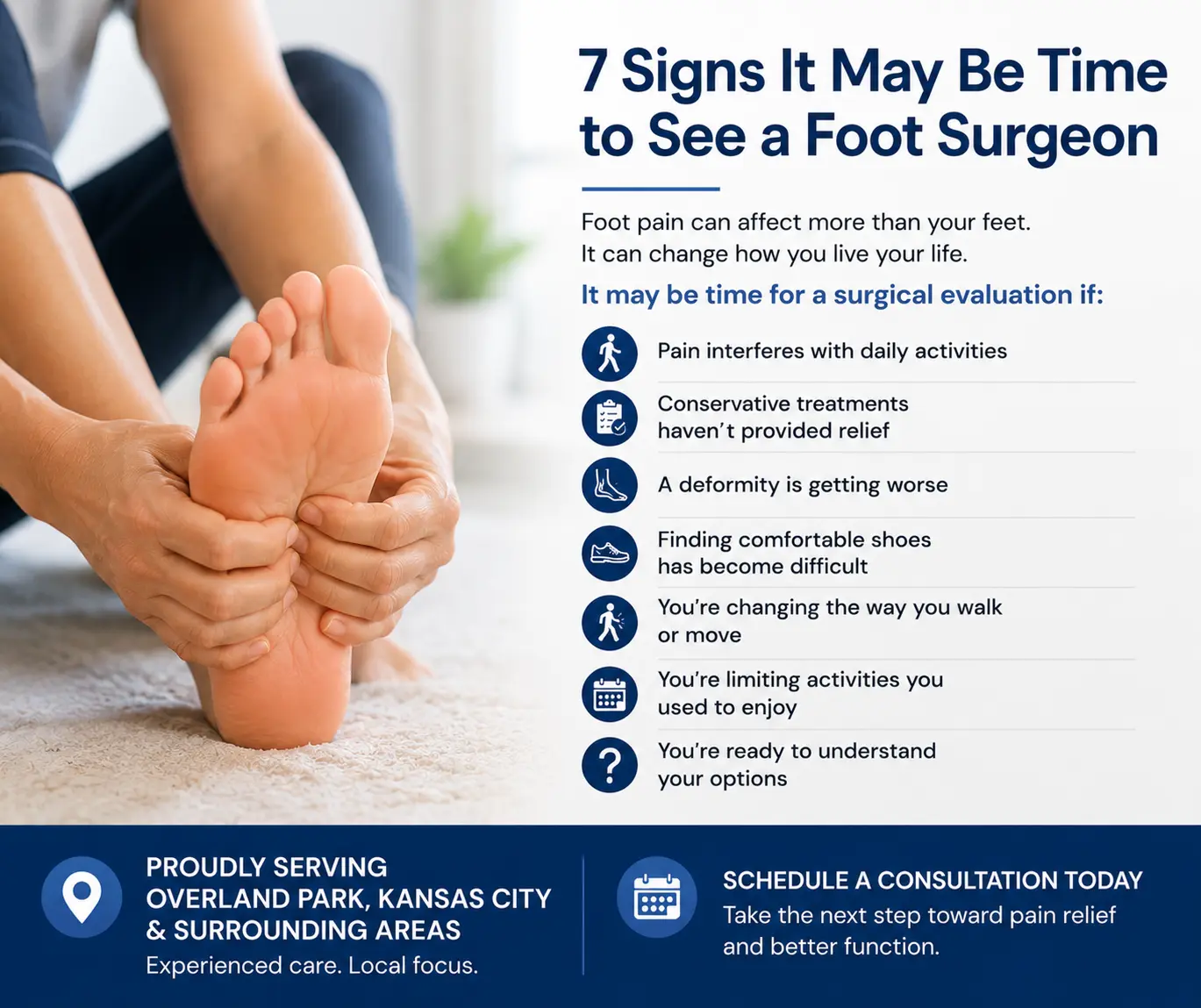
Foot surgery is rarely the first treatment recommended for a painful foot problem. But there can come a point when continuing to live with pain, changing your activities, buying different shoes, or repeatedly treating symptoms is no longer solving the underlying problem.
So how do you know when it may be time to consider surgery?
For many patients, the answer depends less on how a foot looks and more on how much the condition is affecting daily life, whether it is progressing, and whether appropriate nonsurgical treatments have provided enough relief.
At KC Foot Care, Dr. Thomas Bembynista has cared for patients in the Kansas City area for more than four decades. His approach is conservative first: understand the problem, consider appropriate nonsurgical treatment, and recommend surgery only when it is warranted.
If you're wondering whether you've reached that point, here are seven signs that it may be time for a surgical evaluation.
1. Your Foot Pain Is Interfering With Everyday Life
One of the most important questions isn't simply, "How badly does my foot hurt?"
It's:
"What is my foot stopping me from doing?"
Maybe you've stopped taking your normal walk because your bunion hurts.
Perhaps standing through a workday has become difficult.
You might be avoiding certain shoes, cutting workouts short, skipping activities, or planning your day around how long you think you can stay on your feet.
When a structural foot problem begins consistently affecting mobility and quality of life, it's worth finding out whether there is a more definitive treatment available.
That doesn't automatically mean surgery. It does mean the problem deserves a closer look.
2. Conservative Treatments Haven't Provided Enough Relief
Many foot and ankle problems can be treated successfully without surgery.
Depending on the diagnosis, conservative care may include changes in footwear, padding, orthotics, activity modifications, injections, medications or other treatments.
That's why Dr. Bembynista's philosophy is to use conservative treatment before considering surgical correction whenever appropriate.
But conservative care has limitations.
For example, nonsurgical treatments may help relieve bunion pain and pressure, while surgery may be considered when pain continues to interfere with daily activities despite conservative treatment. The American College of Foot and Ankle Surgeons provides additional patient education on bunion treatment and when surgery may be considered.
If you've appropriately tried nonsurgical treatment and the problem continues to interfere with your life, it may be time to discuss what comes next.
3. Your Foot Deformity Is Progressing
Conditions such as bunions and hammertoes can change over time.
A bunion may become larger or more painful. The big toe can begin moving toward the neighboring toes. Hammertoes may become increasingly contracted or rigid. Shoes that once fit comfortably may begin rubbing against prominent joints or toes.
Progression matters because foot problems don't have to be judged solely by today's symptoms.
A surgical evaluation allows your doctor to assess the structure of the foot, review imaging when appropriate, and discuss whether continued conservative management or surgical correction makes sense.
4. Your Shoes Are Being Chosen by Your Foot Problem
Take a look at your shoes.
Have you gradually eliminated certain styles because they hurt?
Are you buying wider and wider shoes to accommodate a bunion?
Does a hammertoe rub against the top of nearly every shoe?
Do you remove your shoes as soon as possible because of pressure or irritation?
Those may sound like minor inconveniences, but they can be important signs of how much a structural problem is affecting your life.
Footwear modifications can be an excellent conservative strategy. But when the deformity itself makes comfortable footwear increasingly difficult, a surgical consultation may help you understand your options.
5. You're Developing Problems in Other Parts of the Foot
The foot functions as a connected mechanical structure.
When one part changes, pressure and movement can change elsewhere.
A progressing bunion, for example, may eventually affect neighboring toes. Hammertoes, painful calluses and areas of increased pressure can develop alongside structural deformities.
This is another reason not to evaluate a foot problem based solely on the location that hurts most.
A comprehensive examination can help determine what's causing the problem and whether multiple symptoms are connected.
6. You've Been Told You Need Surgery, But You're Not Comfortable With the Plan
Being told that you need foot surgery can generate a lot of questions:
Is surgery really necessary?
Are there nonsurgical options I haven't tried?
Which procedure is appropriate for my foot?
How long will recovery take?
Will I be able to walk after surgery?
What happens if I wait?
Those are reasonable questions.
A second opinion can be particularly valuable before elective foot surgery. Different conditions can require very different approaches, and even patients with the same general diagnosis may not require exactly the same procedure.
Getting another surgical opinion doesn't commit you to having surgery. It gives you more information before making the decision.
7. You're Ready for a More Definitive Conversation About the Problem
Sometimes the biggest sign is simply that you're tired of managing around your foot.
Maybe you've dealt with the same bunion, hammertoe, bone spur or other painful condition for years.
You've accommodated it.
You've adjusted.
And now you're ready to understand whether something more can be done.
A surgical consultation is not a commitment to surgery.
It's an opportunity to get a diagnosis, understand why the problem is occurring, review the appropriate treatment options, and make an informed decision.
What Foot Problems May Require Surgery?
Whether surgery is appropriate depends on the individual diagnosis and severity of the condition.
Dr. Bembynista evaluates and treats a range of conditions that may sometimes require surgical treatment, including:
- Bunions
- Tailor's bunions
- Hammertoes and overlapping toes
- Painful bone spurs
- Certain cases of Morton's neuroma
- Certain chronic heel pain conditions, including plantar fasciitis in appropriate cases
- Other painful structural foot deformities
Some patients may also be candidates for minimally invasive techniques.
For patients with certain bunion deformities, Lapiplasty may be one of the surgical correction options considered based on the structure and severity of the deformity.
At KC Foot Care, minimally invasive foot surgery may be used for selected conditions such as hammertoes, bone spurs, painful calluses and certain forefoot deformities. These techniques use small incisions and specialized instrumentation to correct the underlying problem while limiting disruption to surrounding tissue.
The right procedure depends on the condition, its severity, your foot structure and your individual needs.
What Happens During a Foot Surgery Consultation?
A good surgical consultation should help you understand both why you're having the problem and what your options are.
Dr. Bembynista evaluates the foot, discusses your symptoms and previous treatment, and uses imaging when appropriate to understand the underlying structure.
If conservative care remains appropriate, that may still be the recommendation.
If surgery is indicated, the discussion should include the procedure being recommended, why it is appropriate for your condition, expected recovery and what alternatives may be available.
The objective isn't simply to schedule an operation.
It's to determine the right treatment for the right patient.
Does Seeing a Foot Surgeon Mean I'll Need Surgery?
No. A surgical consultation does not mean you will automatically need foot surgery.
Many foot problems can still be managed conservatively. The purpose of an evaluation is to determine the diagnosis, severity of the problem and appropriate treatment options.
In fact, seeing an experienced foot surgeon can be helpful even when you're hoping to avoid surgery because you can better understand where conservative treatment ends and when surgical correction may become reasonable.
Is Minimally Invasive Foot Surgery an Option?
For certain foot problems, it may be.
Minimally invasive foot surgery uses very small incisions and specialized instruments to perform selected corrections. Dr. Bembynista performs minimally invasive procedures for certain conditions, including selected hammertoes, bone spurs and other forefoot problems.
However, "minimally invasive" doesn't automatically mean it is the best technique for every patient.
The procedure should fit the problem, not the other way around.
Frequently Asked Questions About Foot Surgery
How do I know if I really need foot surgery?
Surgery may be considered when a structural foot problem causes persistent pain, limits activity, progresses over time or fails to improve sufficiently with appropriate conservative treatment. The decision should be based on your diagnosis, symptoms, foot structure and goals.
Should I get a second opinion before foot surgery?
A second opinion can be valuable, particularly if you're uncertain about the diagnosis, recommended procedure or whether you've adequately explored nonsurgical treatment. A second opinion can provide additional information without committing you to surgery.
Can bunions be corrected without surgery?
Conservative treatment may reduce bunion pain and pressure, but it does not reverse the underlying structural deformity. When a bunion becomes painful or increasingly limits activity despite conservative treatment, surgical correction may be considered.
Can hammertoes be treated without surgery?
Flexible or early hammertoes may respond to conservative care such as footwear changes, padding and orthotic support. More rigid, painful or progressive hammertoes may require surgical correction.
How long is recovery after foot surgery?
Recovery varies considerably depending on the diagnosis and procedure. Some minimally invasive procedures allow relatively quick return to normal footwear and activities, while more extensive reconstructive procedures require a longer recovery. Your surgeon should explain the expected timeline for your specific procedure.
Can I walk after foot surgery?
That depends entirely on the procedure. Some foot procedures allow protected walking shortly after surgery, while others require greater restrictions. Your surgeon will provide instructions based on the procedure performed.
Foot Surgery and Second Opinions in Kansas City and Overland Park
If you've been living with a painful foot problem, have already tried conservative treatment, or have been told you need surgery and want another opinion, the next step doesn't have to be making a decision about surgery.
It can simply be getting better information.
Dr. Thomas Bembynista has been caring for patients in the Kansas City area for more than four decades and is board certified by the American Board of Podiatric Surgery. His approach begins with conservative treatment whenever appropriate, with surgical correction considered when it is the right option for the individual patient.
KC Foot Care serves patients from Overland Park, Johnson County, Kansas City and surrounding Kansas and Missouri communities.
Ready to understand your options? Request a surgical consultation or second opinion with Dr. Bembynista.
About the author

Jessica Harrison is a compassionate healthcare advocate based in Austin, TX. With years of experience navigating the complex healthcare landscape, she understands the challenges many face when searching for the right medical support. Jessica is dedicated to empowering individuals by providing valuable insights, practical advice, and the latest information on healthcare resources, making the journey to finding a trusted doctor less daunting. Her engaging approach has helped countless people regain control of their health and well-being.